Conversation Structures and Graphs
An example of each, which you might want to try out

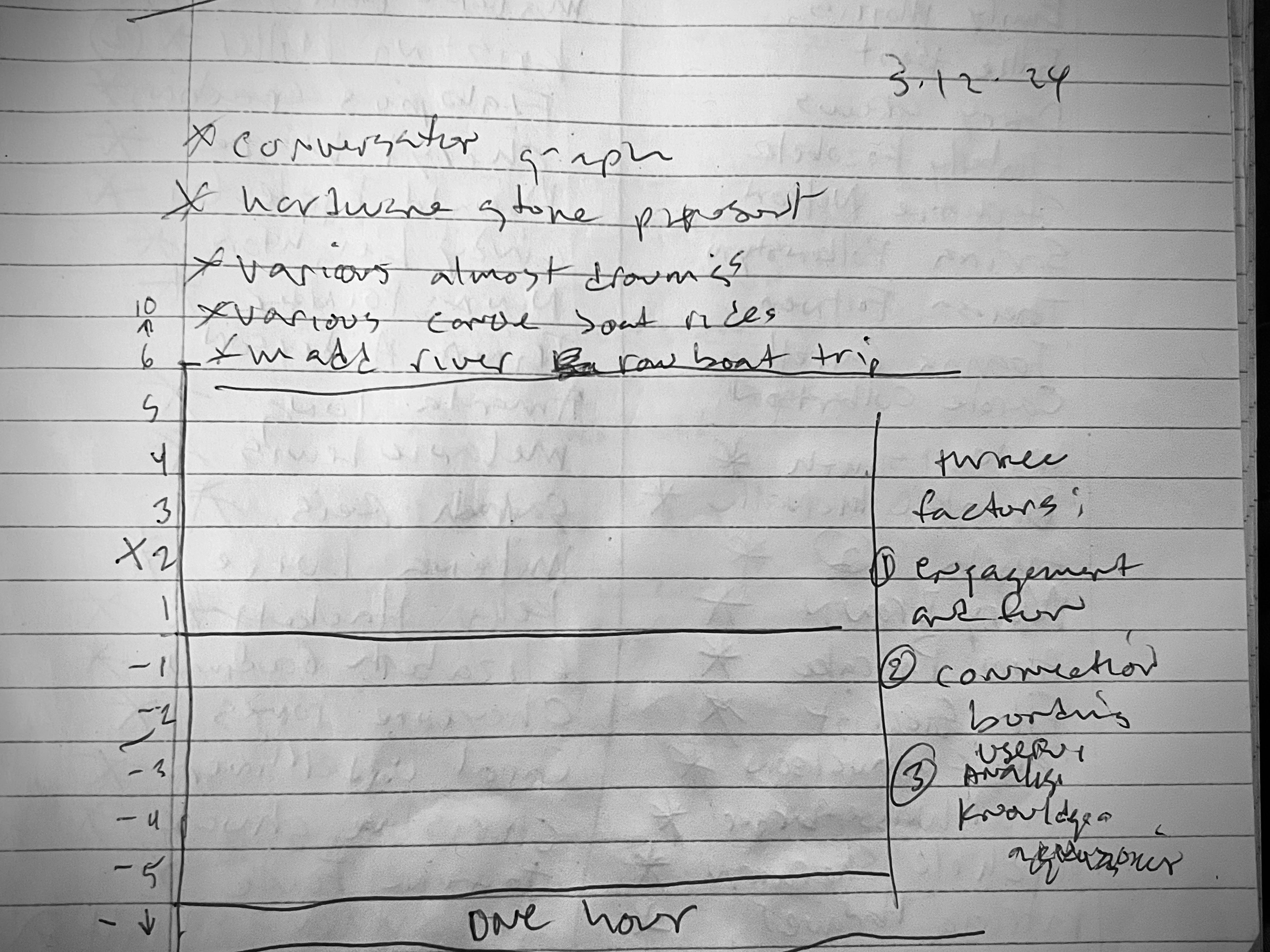
I’ve been interested in conversation structures for a long time. I speculate that because I’m a shy person, and casual conversation has never come easily for me, I’ve had to intentionally construct my approach to talking with people, which has given me a greater sensitivity to conversation structures (existing and potential ones) than other people who are more naturally social.
As mentioned in previous posts, I’m a fan of asking questions and think that the addition of thoughtful and curious inquiry is a simple way to bump up anyone’s conversation game. Unfortunately, from my perspective, most people don’t ask questions very much at all, especially open-ended ones with an “understanding framework.”
A while ago while I was teaching a university class, in which question asking was not in great supply, I suggested trying out a conversation structure, sort of like a game, to see if that would be helpful in increasing engagement. This was the structure I suggested:
One person starts the conversation by making a brief statement on a topic of their choice (no longer than a minute or two) and then asks a question of someone else related to their topic. That selected person answers the question in a statement of their own and then asks a question of someone else, and so on until the conversation is concluded.
The students seemed confused by the instructions and one of them said something to the effect of, “That’s just a normal conversation.”
I begged to differ and, with a general, though somewhat reluctant, agreement to give it a try, I made the first statement and asked the first question. The process played out, a little awkwardly at first as is prone to happen when a person or group of people are trying a new activity, and then slowly gained momentum as everyone got more accustomed to how the structure worked. Afterwards, the students responded positively. That was one of the last university classes I taught, so I’ve yet to try it again with a group. (At the prison, where I co-organize a writing workshop with Laura Glazer, there is no shortage of question asking.)
I’ve been meaning to see how it would work with just two people, and I’ve had lots of opportunities to make that attempt, but so far I’ve either forgotten to suggest doing it or the person I’ve wanted to try it out with has been resistant. I do think it might be a useful structure to implement from time to time though, because using it, even just as practice, could help with the process of creating a habit of asking questions in general.
Another idea I had a while ago that I haven’t tried out at all is what I call “graphing a conversation.” When I came up with the idea, I presented it separately to the two people I have conversations with most frequently and they both hated the concept and shot it down immediately. That kind of put a damper on trying out the idea a little.
Here is how the idea went:
Two people have a conversation for a given period of time, let’s say an hour just as an example. Immediately after the conversation they each attempt to graph the course of the hour using three evaluation criteria:
1. Engagement and fun
2. Connection and bonding
3. Useful analysis and knowledge acquisition
I’m open to other criteria as well, but those ones were what first came to mind.
So, what a participating person would do is try to recall the nature of the conversation and to what degree each of those three factors was and wasn’t occurring during the hour. My thought was that there would be a neutral horizontal baseline in the middle of the graph that represented zero and then above that would be lines showing plus 1-10 and below would be minus 1-10. The participants would then try giving values to each of the three criteria over the course of the hour. (As anyone who uses or makes graphs regularly will undoubtedly conclude, I’m at best a nascent grapher, in fact I’ve been mostly graph-averse most of my life, but you know, it’s always a good idea to try out new things.)
Once the graphs had been independently completed the two people could compare what they came up with and see how they differed, or not, in their estimations and opinions of the conversation.
I’m not suggesting that people should always graph their conversations, similar to the previously discussed conversation structure idea, I see it more like a game that people might engage in once in a while, but which could, as with that other concept, help form useful conversation habits.
In the cases of the negative responses my conversation partners gave me to the graphing idea it was partly because they thought it would inhibit conversation so that it didn’t happen naturally. But to me, as I mentioned earlier, conversations aren’t natural to begin with, so I don’t mind messing with them, especially if the results are to potentially make improvements.
A note on my three graphing criteria frameworks:
I really value what I think of as meaningful conversations and I’ve noticed that those three categories, when a conversation works well, are often present.
In the case of the first one I want the time spent during a conversation to be fun and engaging (which is probably one of the reasons why I avoid small talk, which I don’t find fun or engaging).
For the second category I like it when discussions increase my sense of connection and understanding with another person, making me feel more bonded and friendly with them.
And thirdly, I want to use a conversation to help me analyze ideas and subjects with another person’s perspectives. By doing that I can have greater understanding, and potentially even have my mind changed, through openness to evidence and explanations. Acquiring greater knowledge in that way helps me understand the world and my life experiences in more interesting ways.
Just thinking through all of that just now has been helpful to better realize why I have a desire for meaningful communication, even if I never find someone to actually attempt to graph a conversation with me.